



Qingdao Kruto Plastic Machinery Co., Ltd. is located in the beautiful and rich Qingdao City, Shandong Province. We specialize in the production of plastic production extruders and down auxiliary equipment. With more than 20 years of experience in plastic machinery manufacturing, with a serious attitude towards customers and a responsible mentality, we absorb the design concepts of European experts and hundreds of experimental data to produce efficient single-screw extruders.
Why Choose Us
Rich Experience
Our company has been in the plastic extruder industry for more than 20 years, has accumulated rich experience, and continuously optimizes its own technology and equipment.
Broad Market
Our products are not only popular in China but also sold to more than a dozen countries overseas, and the companies we cooperate with are all over the world.
High Quality Products
Our products will undergo several product inspections before being sent out to ensure product quality. And we have 100% quality assurance responsibility for our customers, and we will be responsible for any quality problems that arise.
Excellent Service
We have online customer service every day to answer your questions about the product, handling the customer complaint and solve problem for customers. Our customer service will also follow up on product usage.
These extrusion machines start with raw plastic or raw materials, melting it down and sending it through a flat die. The plastic sheet extrusion line forms a continuous plastic film that can be trimmed into a large variety of plastic products like weather stripping, plastic panels, and more.
Benefits of Plastic Sheet Extrusion Line
Cost-Effective
The overall process of plastic sheet extrusion line is affordable. Since thermoplastics are less expensive and easier to work with than metals or other materials, the cost of the process can be greatly reduced. Additionally, both the materials used and disposal are cheaper than many other plastic manufacturing processes, such as injection molding.
High-Production Volumes and Efficient Run Times
The machines used in plastic sheet extrusion can run continuously. This means that manufacturing doesn't ever really need to stop. Manufacturing using this process can produce large quantities of products in a short period, reducing the risk of inventory shortages.
Flexible Design
The flexibility that plastic sheet extrusion offers is nearly unparalleled. Many materials can be used to create various designs. From PVC to polyethylene and so much more, the number of materials used for the creation of these products is vast. Additionally, it is possible to create dies of various shapes and sizes, allowing manufacturers to create the exact product you need with ease.
Easy Finishing
Finishing and assembly services can easily be added to the fabrication process of sheet extrusion. Whether in-line operations are needed or finishing and assembly services, they can be completed with minimal disruption.
Consistency
Manufacturing products using sheet extrusion allows for consistent cross-sections on all parts, indicating a high level of quality. The process itself maintains tight tolerances and is able to create products that meet stringent standards repeatedly.
Co-Extrusion
When using sheet extrusion as your manufacturing process, you are able to utilize co-extrusion, where you extrude two or more different polymers simultaneously. This creates complex products with varying properties in a single piece, ultimately increasing functionality.
Applications of Plastic Sheet Extrusion Line
Packaging
In the packaging industry, plastic sheet extrusion line plays an essential role. It's used in the creation of various packaging materials, including heat-shrinkable film, food-grade plastic wrap, and moisture-resistant plastic bags. These materials provide the necessary protection and extend the shelf life of numerous products.
Pipes and Tubing
The plastic sheet extrusion line is widely used in the production of plastic pipes and tubing. These pipes and tubes come in different sizes and are used in various applications, from small medical tubes to large diameter pipes used in irrigation and sewage systems.
Window Profiles
Extrusion is an important process in the production of window profiles. These extruded profiles are durable, easy to install, and can withstand various weather conditions, making them an excellent choice for construction and home improvement projects.
Wire and Cable Coating
Plastic extrusion is also extensively used for wire and cable coating. The extruded plastic provides electrical insulation and protection against environmental factors, enhancing the longevity and performance of wires and cables.
Seals and Gaskets
Seals and gaskets produced through the plastic sheet extrusion line are used in many industries, including automotive and construction. These seals are resistant to high temperatures and various chemicals, ensuring the secure functioning of different systems.
Filaments for 3D Printing
With the rise of 3D printing technology, plastic sheet extrusion line has found a new application. Filaments used in 3D printers are typically made through the plastic extrusion process.
Sheet and Film Production
Plastic sheets and films used in many industries, including agriculture, construction, and electronics, are typically made using plastic extrusion. These products can be customized to meet specific thickness and transparency requirements.
Synthetic Fibers
The textile industry utilizes plastic extrusion in the production of synthetic fibers. These fibers are then used in the creation of various fabrics and textiles.
Extruder
The extruder is a machine consisting of a heated cylinder with an internal motor driven screw that plasticizes and pumps out the polymer.
Screen Changer
The screen changer is a more or less continuous device to filter impurities from the molten polymer in order to avoid shutting down the machine when the screen is full.
Gear Pump
A gear pump is a device including two intermeshing gears driven and rotating in a close-fitting housing to provide precise volumetric output. It is usually run with an upstream pressure controller to maintain uniform input pressure from the extruder.
Static Mixer
A static mixer is a mechanical housing that contains fixed vanes that break up the polymer flow into small streams before recombining them to homogenize the polymer flow for uniform melt viscosity prior to entering the die.
Coextrusion Feedblock
A coextrusion feed block is a device preceding a flat sheet or film extrusion die, which combines the flow of several extruders with different materials into multiple uniform layers emerging from the die.


Flat Sheet Die
A flat (sometimes called T) sheet extrusion die is a heated distribution chamber to receive the uniformly molten polymer at a central entrance and extrude it through adjustable die lips into a flat exiting sheet of desired thickness. It may also include an internal adjustable restrictor (Choker) bar to assist in providing a uniform output across the entire width. The main transversal flow passage is called the manifold. It may have variable cross-sections and tapers to assist in providing the uniform polymer distribution.
Roll Stack
Roll stack is a colloquialism for a sheet take-off, the three roll cooling system most commonly employed to cool sheet right after it comes out of the die. This is also sometimes called a calender which it also resembles.
Sheet take-off device
The sheet take-off generally consists of three vertically oriented hardened chrome plated rolls, each with its own temperature controlled water (or other fluid in some higher temperature cases). These can be gang driven via a chain or individually driven. The middle roll is fixed in position while the outer two are pressure loaded via air or hydraulics against it. The unit is usually run down stack for thinner sheet and up stack for thicker sheet. There are also inclined and offset roll versions, and others with additional non-contacting cooling rolls for higher cooling capacity.
Temperature Control of The Extruder Host
The plastic extrusion of wire and cable insulation and sheathing is carried out in a viscous flow state according to the deformation properties of thermoplastics. In addition to requiring external heating of the screw and barrel, which is transmitted to the plastic to melt and extrude, the heat generated by the screw itself when extruding the plastic is also required. Therefore, the temperature of the host should be considered as a whole, including the opening and closing of the heater. It is necessary to consider the factor of the extrusion heat overflow of the screw to cool it, and there must be effective cooling facilities.
Pressure Control of Extruder
In order to reflect the extrusion situation of the plastic sheet extrusion line head, it is necessary to detect the head pressure during extrusion. Since the domestic extruder does not have a head pressure sensor, the measurement of the thrust after the screw extrusion is generally used instead of the head pressure. In measurement, the screw load table can correctly reflect the size of the extrusion pressure. The fluctuation of extrusion pressure is also one of the important factors that cause unstable extrusion quality. The fluctuation of extrusion pressure is closely related to factors such as extrusion temperature, the use of cooling device, and the length of continuous operation time.
Control of Screw Speed
The adjustment and stability of the screw speed is one of the important technological requirements of the host drive. The screw speed directly determines the amount of glue and the extrusion speed. In normal production, it is always desirable to achieve the highest speed and high output as much as possible. When the screw speed of the extruder is required to be from the start to the required working speed, the available speed regulation range should be large.
Tension Control Required for Winding
In order to ensure the wire take-up at different line speeds and the constant tension requirement from empty reel to full reel, it is hoped that the wire take-up and reel device has a tension adjustment mechanism for storing the wire, or the rewinding of the constant line speed system and the constant tension system is considered electrically and many more.
Selecting the Right Plastic Sheet Extrusion Line
Determining Production Needs and Output
Understanding the production needs and output requirements is the first step in selecting a plastic sheet extrusion line. Factors such as film type, thickness, width, and production capacity should be considered to match the capabilities of the extrusion line to the demands of the industry.
Sheet Properties and Materials Compatibility
Different sheets require specific properties, such as flexibility, tensile strength, and barrier performance. It is essential to assess the sheet properties needed for the target applications and ensure that the sheet extrusion line is compatible with the desired materials. The decision to opt for a single-layer or multilayer sheet extrusion line depends on the desired properties of the sheets and the intended applications. Multilayer extrusion offers enhanced barrier properties and versatility, making it suitable for applications that require specialized sheet characteristics.
Automation and Technology Advancements
Consideration should be given to the level of automation and technology advancements offered by the sheet extrusion line. Modern extrusion lines equipped with advanced controls and monitoring systems improve process efficiency, reduce human errors, and enhance overall productivity. Choosing a reputable sheet extrusion line manufacturer that offers comprehensive after-sales support and service is vital for ensuring smooth operations and minimal downtime. Prompt and reliable service ensures that any issues are addressed promptly, allowing production to run seamlessly.
How to Clean the Screw in Plastic Sheet Extrusion Line Correctly
Select the Correct Heating Device
It is the most common and effective method for plastic processing units to remove the plastic fixed on the screw by burning or baking, but it is absolutely not allowed to use acetylene flame to clean the screw. The temperature of acetylene flame can reach 3000 ℃. Using acetylene flame to clean the screw will not only destroy the metal properties of the screw, but also significantly affect the mechanical tolerance of the screw. If the acetylene flame turns to permanent blue when baking a certain part of the screw, it means that the metal structure of this part of the screw has changed, which will lead to the reduction of the wear resistance of this part, and even the peeling of the wear resistance layer from the base metal. In addition, local heating with acetylene flame will also cause overheating on one side of the screw, which will lead to screw bending. The straightness of the screw is mostly within 0.01mm. When the screw is baked and cooled by acetylene flame, it is usually difficult to return to the original straightness. Correct and effective method: use a blowtorch to clean the screw immediately after use. Because the screw carries the heat during processing, the heat distribution of the screw is still uniform.
Select the Correct Detergent
Today, with the highly developed commodity economy, there are many kinds of screw detergent on the market, most of which are expensive and have different effects. Whether to use commercial detergent depends on different manufacturers and production conditions. Plastic processing enterprises can also use different resins to make screw detergent according to their own production conditions, which can save a lot of money for the unit.
Select the Correct Cleaning Method
The first step to clean the screw is to turn off the feeding plug, that is, to close the feeding port at the bottom of the hopper. Then reduce the screw speed to 15-25r/min, and maintain this speed until the melt flow at the front end of the die stops flowing. The temperature of all heating areas of the barrel shall be set at 200 ℃. Once the barrel reaches this temperature, start cleaning immediately. According to the different extrusion processes (it may be necessary to remove the die head to reduce the danger of excessive pressure at the front of the extruder), so the cleaning must be completed by one person: the operator observes the screw speed and torque from the control panel, while observing the extrusion pressure to ensure that the system pressure is not too high. During the whole process, the screw speed should be kept within 20 r/min. In the application of low-pressure die, do not remove the die for cleaning first. When the extrudate is completely converted from processed resin to clean resin, immediately stop and remove the die head, and then restart the screw (within 10r/min) to make the residual clean resin flow out.
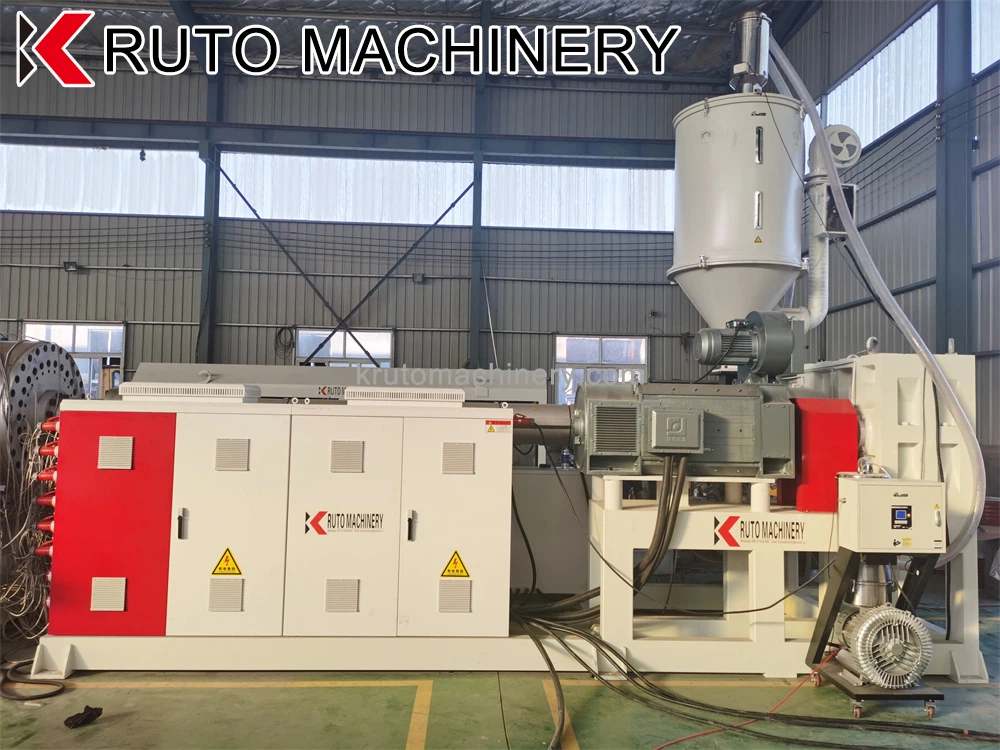
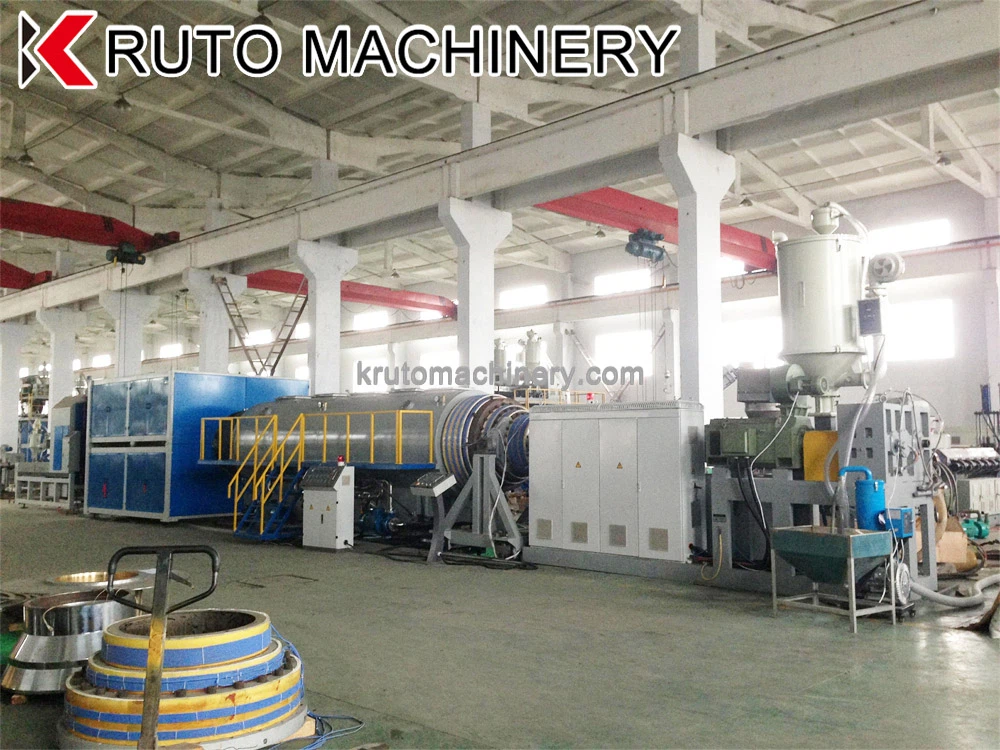
Our Factory
Our factory is strategically located, only 30 minutes away from the airport and port.


Ultimate FAQ Guide to Plastic Sheet Extrusion Line
Q: How to clean the barrel of plastic sheet extrusion line correctly
Q: What are the working principle of plastic sheet extrusion line?
Q: What is the function of plastic sheet extrusion line?
Q: What are the benefits of plastic sheet extrusion line?
Q: What plastics are used in plastic sheet extrusion line?
Q: How to improve Extrusion Efficiency?
Q: What temperature is needed for plastic sheet extrusion line?
Q: What are the material selection criteria for plastic sheet extrusion line?
Q: What are the fundamentals of plastic sheet extrusion line?
Q: What is the maintenance of plastic sheet extrusion line?
Qingdao Kruto Plastic Machinery Co., Ltd. is one of the most professional plastic sheet extrusion line manufacturers and suppliers in China, featured by quality products and good service. Please rest assured to buy customized plastic sheet extrusion line at competitive price from our factory.
Concrete Protective Liner Production Line, impact resistance specification of extruded plastic sheets, Multi point Anchoring PE Board Machine