

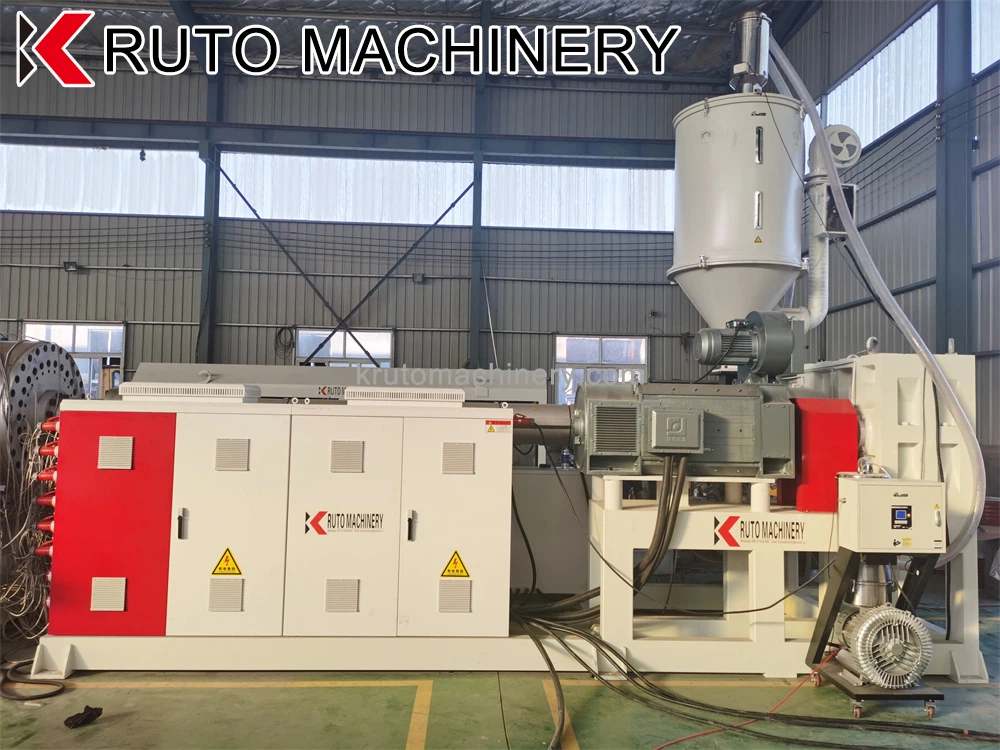
Hollow Wall Winding Pipe Extrusion Line


Qingdao Kruto Plastic Machinery Co., Ltd. is located in the beautiful seaside city Qingdao, Shandong Province. We specialize in the production of plastic production extruders and down auxiliary equipment. With more than 20 years of experience in plastic machinery manufacturing, as well as a serious attitude towards customers and a responsible mentality, we absorb the design concepts of European experts and hundreds of experimental data to produce efficient single-screw extruder.
Why Choose Us
Rich Experience
Our company has been in the plastic extruder industry for more than 20 years, has accumulated rich experience, and continuously optimizes its own technology and equipment.
Broad Market
Our products are not only popular in China but also sold to more than a dozen countries overseas, and the companies we cooperate with are all over the world.
High Quality Products
Our products will undergo several product inspections before being sent out to ensure product quality. And we have 100% quality assurance responsibility for our customers, and we will be responsible for any quality problems that arise.
Excellent Service
We have online customer service every day to answer your questions about the product, handling the customer complaint and solve problem for customers. Our customer service will also follow up on product usage.
The production line designed with advanced technology is mainly for producing large-diameter hollow wall winding pipe. The hollow wall winding pipe production line has a unique shape structure. So it has high ring stiffness and high impact strength and has the characteristics of light quality, easy construction, easy installation, resistance to external pressure and so on. The life span of the pipe is more than 50 years. It is the replacement product of cement pipe, cast iron pipe, and ceramic pipe. It has a wide application prospect and market potential.
Benefits of Hollow Wall Winding Pipe Extrusion Line
High Production Efficiency
One of the most significant advantages of hollow wall winding pipe extrusion line is its high production efficiency. The machinery is designed with advanced features that allow for continuous and uninterrupted operation, leading to increased output. The high-speed extrusion process, coupled with the machinery's ability to handle large volumes of material, ensures that a substantial number of pipes can be produced within a short period. This efficiency is crucial for businesses that need to meet tight deadlines and high demand for their products.
Precision and Quality Control
Hollow wall winding pipe extrusion line is equipped with sophisticated control systems that ensure precision in the production process. The machinery can accurately control the temperature, pressure, and speed of extrusion, which directly impacts the quality of the pipes produced. The consistency in the wall thickness, diameter, and length of the pipes is maintained, leading to a uniform product that meets industry standards. The machinery also includes features that allow for real-time monitoring and adjustments, ensuring that any deviations from the set parameters are immediately corrected.
Versatility in Material Processing
The versatility of hollow wall winding pipe extrusion line is another notable advantage. It can process a wide range of thermoplastic materials, including PVC, HDPE, PP, and others. This versatility allows manufacturers to produce pipes for various applications without the need for additional machinery or equipment. Furthermore, the machinery can be configured to produce pipes of different sizes and shapes, catering to diverse customer needs and preferences.
Energy Efficiency and Cost Savings
Hollow wall winding pipe extrusion line is designed with energy efficiency in mind. The machinery consumes less power compared to traditional extrusion systems, leading to significant cost savings for businesses. The energy-saving features include high-efficiency motors, optimized heating systems, and intelligent control algorithms that minimize energy consumption. Over time, these savings can offset the initial investment in the machinery and contribute to the overall profitability of the business.
Low Maintenance and Durability
The hollow wall winding pipe extrusion line is built with high-quality components and materials that ensure its durability and longevity. The machinery is designed to withstand the rigors of continuous operation with minimal wear and tear. Regular maintenance can be performed with ease, thanks to the user-friendly design and accessibility of the machinery's components. This low maintenance requirement not only reduces operational costs but also minimizes downtime, ensuring that production schedules are not disrupted.
Environmentally Friendly
Hollow wall winding pipe extrusion line is an environmentally friendly option for pipe production. The machinery operates with minimal waste generation, and the scrap material produced during the extrusion process can be recycled and reused. This closed-loop system reduces the environmental impact of plastic pipe manufacturing and aligns with the sustainability goals of many businesses. Additionally, the energy efficiency of the machinery contributes to its green credentials, as it reduces the carbon footprint associated with pipe production.
Advanced Automation Features
The hollow wall winding pipe extrusion line comes with advanced automation features that enhance its capabilities. These features include automatic material feeding, cutting, and stacking systems that reduce the need for manual labor and increase production speed. The automation also ensures that the production process is more consistent and accurate, leading to a higher quality of output. The machinery can be integrated with other automated systems, such as quality control software and inventory management systems, to create a fully automated production line.
Working Principle of Hollow Wall Winding Pipe Extrusion Line
First: Feeding
After the plastic is added to the hopper, it can enter the space of the screw groove by its own weight or under the action of the forced feeder, and is pushed forward under the pushing of the screw edge. However, if the coefficient of friction between the material and the metal hopper is too large, or the internal friction coefficient between the materials is too large, or the cone angle of the hopper is too small, the bridging and hollow tube phenomenon will gradually form in the hopper, and the material will not be smooth. When the ground enters the groove, the extrusion will be forced to stop or extremely unstable. Therefore, if the extrusion productivity is abnormally lowered or not discharged, it is necessary to check the feeding condition and even change the design of the hopper.
Second:Transport
In theory, after the plastic enters the screw groove, every time the screw rotates, all the plastic will carry a lead forward. At this time, we call the transfer rate 1. However, for each screw, the amount of forward transport depends in fact on the friction factor fb of the plastic on the barrel and the friction factor fs of the plastic on the screw. The larger the fb or the smaller the fs, the amount of solid plastic that will be transported forward. The more. Numerous experiments have shown that the friction coefficient of resin to metal mainly depends on the temperature of the system and the surface roughness of the metal or the structure and shape of the system, and is also related to system pressure and material movement speed.
Third: Compression
It is absolutely necessary that the plastic is compressed during the extrusion process. First of all, plastic is a poor conductor of heat. If there is a gap between the particles, it will directly affect its heat transfer, thus affecting the melting rate. Secondly, it will only be between the particles under the pressure gradually increasing along the length of the screw. The gas is discharged from the hopper. Otherwise, the product will become defective or waste due to the bubble inside. In the end, the higher system pressure also ensures that the product is denser.
There are three reasons for the pressure on the screw:
1. In the structure, the screw groove depth gradually becomes shallower, and the material is gradually compressed;
2. The resistance element such as the splitter plate, the filter net and the head is installed in front of the screw head;
3. It is the pressure established along the entire length of the screw caused by the friction of the material against the metal. The smaller the cross-sectional area of the die, the greater the pressure peak will be, and the highest pressure will move toward the nose. Generally speaking, the pressure peak is at the front of the metering section or the back of the compression section.
Fourth:Melting
As the pressure increases, the moving solid plastic continues to contact and rub against the heated barrel wall. The temperature of the plastic material close to the barrel wall continues to increase, reaches the melting point, and forms a thin layer of barrel on the inner wall of the barrel. After melting the film, there are two sources of heat for melting the solid plastic. One is the conductive heat from the external heater of the barrel, and the other is the shear (internal friction) generated in the melted film due to different melt speeds. As the melting progresses, when the thickness of the molten film is greater than the gap between the screw and the barrel, the moving spiral edge scrapes the molten film, forming a molten pool in front of the advancing spiral edge. During the melting process, the molten pool becomes wider and wider, while the remaining solid becomes narrower and narrower until it finally disappears.
Fifth: Mixing
During the extrusion process, under high pressure, the solid material is generally compacted into a dense solid plug. Because there is no relative movement between the particles in the solid plug, the mixing can only be carried out between the layers of the melt with relative motion get on.
Sixth: Exhaust
In the extrusion process, there are three kinds of gases to be discharged, one is the air interposed between the particles, as long as the screw speed is not too high, in general, this part of the gas can be gradually increased pressure from the hopper Discharged. However, when the rotation speed is too high, the material moves forward too fast, and the gas may not be able to be completely discharged, thereby forming bubbles in the product. The second gas is the moisture adsorbed by the material from the air, which becomes water vapor when heated. And the third is some materials inside the plastic particles, such as low molecular volatile, Low-melting plasticizers, etc., which gradually vaporize under the action of heat generated during the extrusion process. Only when the plastic melts, these gases can escape the surface tension of the melt, but at this time, since they are far away from the hopper, Cannot be discharged through the hopper. In this case, a venting extruder has to be used.
Solving Common Problems in Hollow Wall Winding Pipe Extrusion Lines
Material Feeding Issues
One of the primary challenges in hollow wall winding pipe extrusion is ensuring consistent material feeding. Material feeding issues can result in uneven extrusion, leading to dimensional variations in the pipes. Common causes of material feeding problems include improper material conditioning, hopper design issues, and inconsistent material flow rates.
Solution
To address material feeding issues, it is crucial to ensure that the raw material is properly conditioned to the required temperature and moisture content before entering the extruder. Optimizing the design of the hopper and implementing monitoring systems to maintain consistent material flow rates can help mitigate feeding problems.


Melting and Homogenization
Achieving uniform melting and homogenization of the hollow wall winding pipe material is essential for producing high-quality pipes. Inadequate melting or poor mixing can result in uneven distribution of additives and properties, leading to inferior product quality and performance.
Solution
To optimize melting and homogenization, it is essential to control the temperature profile within the extruder barrel carefully. This can be achieved by adjusting heating and cooling zones along the barrel length to ensure proper melting and mixing of the material. Furthermore, incorporating mixing elements such as screws or static mixers can enhance material homogenization and distribution.
Die Design and Calibration
The die plays a critical role in shaping the molten hollow wall winding pipe material into the desired pipe dimensions. Issues with die design or calibration can result in variations in pipe diameter, wall thickness, and surface finish, leading to product defects and performance issues.
Solution
Ensuring proper die design and calibration is essential for achieving consistent pipe dimensions and surface quality. This can be achieved through meticulous design and optimization of die geometry, including the entrance and exit angles, land length, and die gap. Regular calibration and maintenance of the die assembly are necessary to ensure accurate control of pipe dimensions during extrusion.
Cooling and Sizing
Proper cooling and sizing of the extruded pipe are crucial for controlling its dimensional stability and mechanical properties. Inadequate cooling or sizing can lead to issues such as warping, shrinkage, or uneven wall thickness, affecting the overall product quality and performance.
Solution
Optimizing the cooling and sizing process involves controlling the cooling rate and maintaining uniform cooling across the circumference of the pipe. This can be achieved by using water or air cooling systems with adjustable flow rates and temperatures. Implementing precision sizing tools such as vacuum or pressure sizing sleeves can help ensure accurate control of pipe dimensions during the cooling process.
Extrusion Line Maintenance
Regular maintenance of the hollow wall winding pipe extrusion line is essential for preventing downtime and ensuring consistent production quality. Neglecting maintenance can lead to equipment failure, decreased productivity, and increased production costs.
Solution
Developing a comprehensive maintenance schedule that includes routine inspections, cleaning, lubrication, and component replacement is essential for keeping the extrusion line operating smoothly. Investing in predictive maintenance technologies such as vibration analysis and thermal imaging can help identify potential issues before they escalate into major problems, minimizing downtime and production losses.

What Should be Considered When Choose Hollow Wall Winding Pipe Extrusion Line
Quality is the top concern at the market end. Excluding the factors of raw materials, the machine operation can affect the quality and durability of the pipe from the beginning to the end. The mixing at the hopper needs to be efficient and thorough, and the material distribution needs to be uniform. As the PVC is highly sensitive to temperature, the temperature and pressure control of the extruder and the screw torque control must be precise for the pipe to balance the plasticization, mechanical properties, and product quality. Then, the speed and handle of the haul-off units need to be accurate and stable to avoid deformation.
Production capacity and efficiency is the key to a production-oriented company's success. So, there are a couple of factors to consider in the hollow wall winding pipe extrusion line. The most obvious is the operation speed of the machine, as the faster the production, the higher the efficiency. The second factor is the length and number of the extruder screw. Double screw design can significantly increase the processing capacity as it can accommodate and process more mixtures within a certain period. At the same time, a longer screw can counter the adverse effects of shorter residence time of material in the extruder and affords a more homogeneous melt. Advanced control systems, monitoring sensors, and computerized interfaces also matter as they optimize the coordination between different parts of the production line and the working efficiency of the operators.
With the integration of intelligent technology, accurate sensors, and automation, the whole production section can be monitored, managed, and adapted in real-time, reducing overall waste and energy consumption.
As hollow wall winding pipe extrusion lines tend to be highly technical and heavily used, reliable and professional after-sale support can provide lots of added value. When machine faults occur, swift after-sales support can drive down the time required for repair and, hence, minimize the downtime loss for the clients. During daily operations, a responsive and professional after-sales team can then assist the clients with technical advice on improving the efficiency and lifespan of the machines, enhancing the long-term ROI on the hollow wall winding pipe extrusion line.
Our Factory
Our factory is strategically located, only 30 minutes away from the airport and port.


Ultimate FAQ Guide to Hollow Wall Winding Pipe Extrusion Line
Q: What are the features of hollow winding pipe production line?
Q: How to Effective Operation of Hollow Wall Winding Pipe Extrusion Line?
Q: What are the mechanical principle of hollow wall winding pipe extrusion line?
Q: How Does Pipe Extruder Work?
Q: What Does The Extruder Die Do?
Q: What Is The Difference Between An Extruder And An Injection Molding Machine?
Q: How frequently should I clean my pipe extruder?
Q: What is the extruder process?
Q: What are the applications of plastic extrusion machines in various industries?
Q: What are the main parts of an extrusion machine?
Qingdao Kruto Plastic Machinery Co., Ltd. is one of the most professional hollow wall winding pipe extrusion line manufacturers and suppliers in China, featured by quality products and good service. Please rest assured to buy customized hollow wall winding pipe extrusion line at competitive price from our factory.
pvc hollow wall winding pipe extrusion inspection, maintenance of hollow wall winding pipe extrusion line, pp hollow wall winding pipe extruding workshop