

Plastic Pipe Extrusion Line


Qingdao Kruto Plastic Machinery Co., Ltd. is located in the beautiful seaside city Qingdao, Shandong Province. We specialize in the production of plastic production extruders and auxiliary equipment. With more than 20 years of experience in plastic machinery manufacturing, as well as a serious attitude towards customers and a responsible mentality, we absorb the design concepts of European experts and hundreds of experimental data to produce efficient single-screw extruders.
Why Choose Us
Rich Experience
Our company has been in the plastic extruder industry for more than 20 years. We have accumulated rich experience and we are continuously optimizes our own technology and equipment.
Broad Market
Our products are not only popular in China but also sold to dozens of countries overseas, and the companies we cooperate with are all over the world.
High Quality Products
Our products will undergo several product inspections before being sent out to ensure product quality. And we have 100% quality assurance responsibility for our customers, and we will be responsible for any quality problems that arise.
Excellent Service
We have online customer service every day to answer your questions about the product, handling the customer complaint and solve problem for customers. Our customer service will also follow up on product usage.
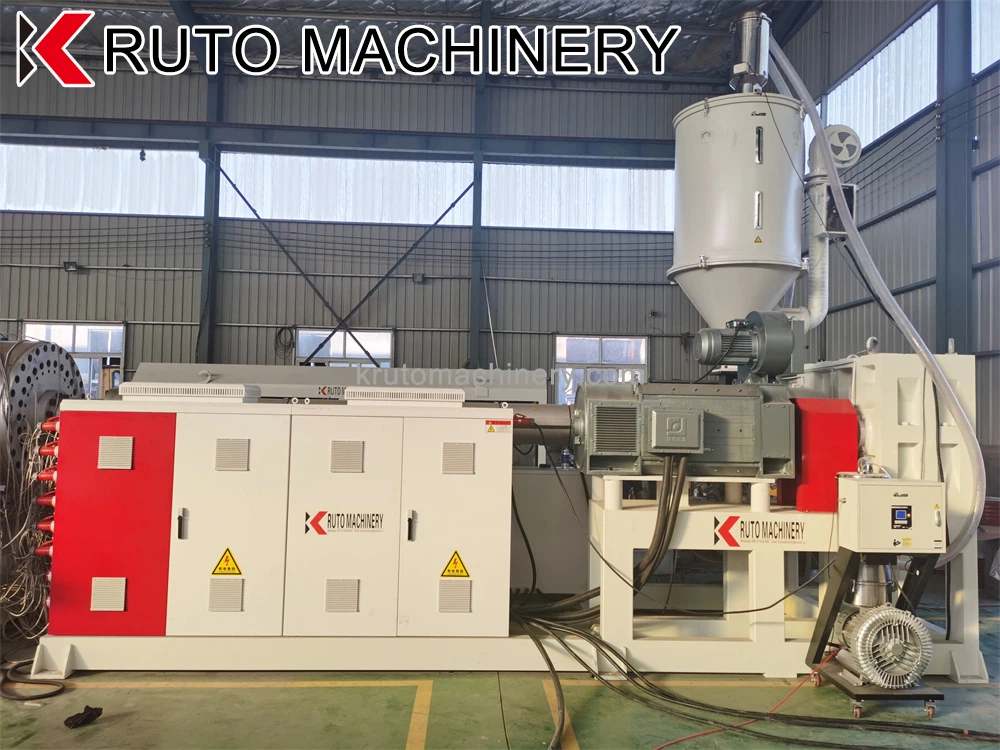
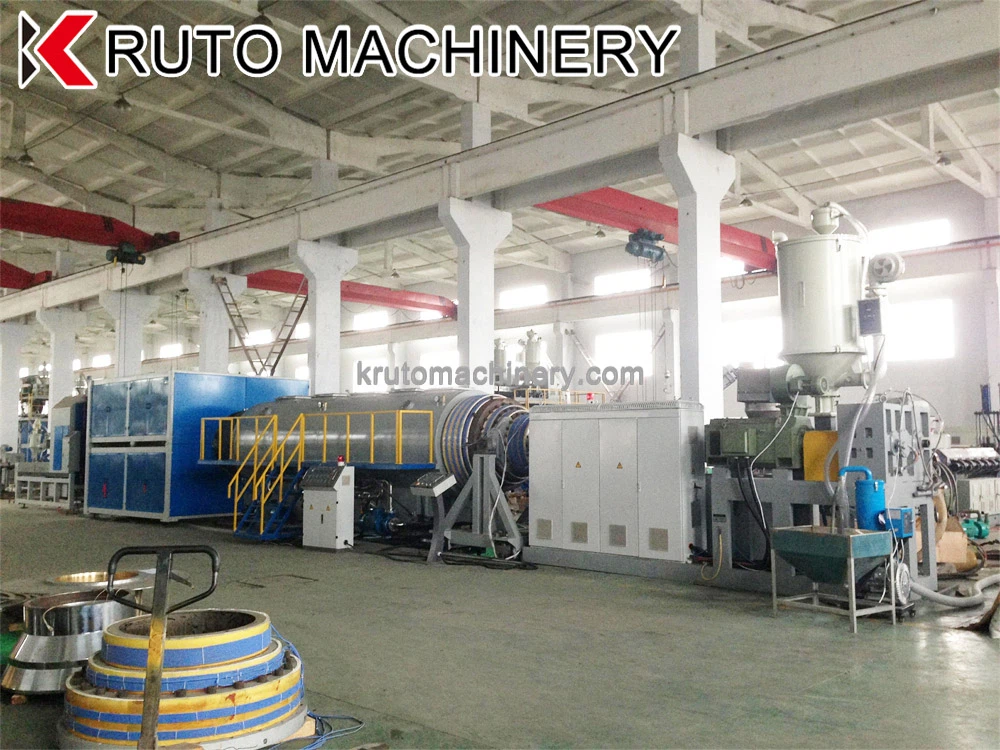
A plastic pipe extrusion line consists of different parts. An extruder converts raw plastic material into a continuous tubular melt by extrusion through an annular die. The molten pipe then proceeds through a sizing or calibration bench (which adjust its dimensions) to a cooling tank. After being cooled, the pipe passes via a haul-off to the cutting machine, for cutting it into final lengths, or coiling.
Benefits of Plastic Pipe Extrusion Line
Versatility
Plastic pipe extrusion line can be produced in a wide range of shapes and sizes, allowing for a high degree of customization to meet specific project requirements. They can also be made in a variety of colors and finishes, providing an aesthetic appeal. Plastic pipe extrusion line provides versatility in the products being created with a consistent cross-section. The extrusion die can produce complex shapes as long as the cross-section remains the same. Since the manufacturing process is flexible, it can be used for plastic sheets or to produce products that require different attributes.
Cost-Effective
Compared to other plastic processes, plastic pipe extrusion line has a lower cost and is more efficient. The plastic pipe extrusion line uses thermoplastics and granules that go through melting and hardening processes, allowing the waste to be reused. Because of this, the raw material and disposal costs are typically lower. Plastic pipe extrusion lines can operate 24 hours a day, reducing the chances of inventory shortage.
Durable
Plastic extrusions are resistant to corrosion, moisture, and chemicals, making them ideal for use in harsh environments. They are also less susceptible to damage from impact, reducing the need for frequent repairs or replacements.
Energy-Efficient
Plastic extrusions have good insulating properties, making them effective for use in energy-efficient building designs. They can also be made with recycled materials, reducing their environmental impact.
Components of Plastic Pipe Extrusion Line
Die Head Part
Plastic that has been compacted, melted, and homogenized through mixing, with subsequent materials pushed towards the die head through screws. The extrusion die head is a crucial component for pipe forming.
Vacuum Sizing Water Tank Part
Adopting our company's independently developed cooling and sizing system, a specially designed stainless steel box with an extended vacuum sizing box, coupled with circulating water spray cooling, can ensure stable diameter size and roundness. The use of speed control system ensures stable traction speed. And the vacuum sizing water tank is equipped with a forward and backward movement device and a manual device for adjusting left and right, height and height
Cutting Machine Part
After being controlled by a travel switch according to the required length, automatic cutting is carried out, and the frame is flipped with a delay to implement flow production. The cutting machine completes the entire cutting process with the fixed length switch signal as the command, and is synchronized with the pipe operation during the cutting process. The cutting process is completed by electric and pneumatic drives.
The Turnover Rack Part of The Pipe Production Line
The turnover action is controlled by the air cylinder through the air circuit. The turnover installation is equipped with a limit device. When the cutting saw cuts the pipe, the pipe continues to be transported. After a delay, the cylinder enters work to achieve the turnover action and achieve the unloading purpose. After unloading, it will automatically reset after a delay of several seconds, waiting for the next cycle.
1. Melting of the Raw Plastic Materials
The raw plastic materials such as beads, granules, pellets, or powder are loaded into a hopper and then fed into a long heated cylindrical chamber called an extruder. The plastic materials melted down is moved through this extruder by a spinning bolt. It is important to note that some extruders can have either one or two spinning bolts.
2. Filtration of the Melted Plastic Materials
The melted raw materials flow from the hopper down through the feed throat and onto a large spinning screw operating within a horizontal barrel of the mini single screw extrusion machine. Within the horizontal barrel, the melted raw materials are filtered to ensure a uniform consistency.
3. Sizing of the Molten Plastic
The properties of plastic materials vary depending on the materials there are made of. However, the raw materials are processed by subjecting it to heating at a particular temperature with respect to the type of raw material being passed through. At the completion of the process, the molten plastic is pushed through a small opening called a die. This allows the material to size or shape to the desired finished product.


4. Workup Process
The die-cut for a particular plastic profile is designed to aid smooth and even flow from the cylindrical profile of the extruder into the final profile shape. Consistency in the plastic flow is crucial in achieving an end product with high quality and reliability.
5. Cooling of the Processed Raw Material
As the plastic is extruded from the die, it is fed onto a conveyor belt for cooling. The finished product can be cooled either by air or water. Note, this process is similar to the injection molding process except that the melted plastic is forced through a die instead of into a mold.
Common Challenges in Plastic Pipe Extrusion Lines and How to Solve Them
A fundamental challenge in plastic pipe extrusion lies in maintaining the consistency and quality of raw materials. Variations in material properties, such as viscosity, melt flow rate, and moisture content, can introduce instability into the extrusion process, resulting in defects in the final product. To tackle this challenge effectively, it is imperative to implement stringent quality control measures throughout the supply chain. This includes rigorous testing and inspection of incoming raw materials, as well as adherence to strict storage and handling protocols to prevent contamination or degradation.
Temperature management is paramount in plastic pipe extrusion, as it directly influences the melting and flow characteristics of the polymer. Deviations from the optimal temperature range can lead to a myriad of issues, including melt fracture, poor fusion of pipe joints, and uneven wall thickness. To address temperature-related challenges, operators must meticulously calibrate and maintain the heating and cooling systems of the extrusion line. Regular monitoring of temperature sensors, coupled with timely adjustments, ensures uniform heating and cooling profiles along the length of the extruder, thereby optimizing product quality and consistency.
The design and configuration of the extrusion die play a pivotal role in determining the quality and performance of the final product. Challenges such as die swell, melt fracture, or inadequate flow distribution can arise if the die geometry is not optimized for the specific application. Collaborating closely with die manufacturers to customize dies according to the desired pipe specifications is essential for overcoming these challenges. Furthermore, routine maintenance and cleaning of the die assembly are crucial to prevent the accumulation of contaminants or residue that could compromise extrusion quality.
Achieving optimal production output while maintaining stringent quality standards poses a perennial challenge in plastic pipe extrusion. Operating the extrusion line at higher speeds to boost throughput can introduce risks such as melt instabilities, insufficient cooling, or material stretching. Conversely, running the line at lower speeds may result in underutilization of resources and increased production costs. Striking the right balance between line speed and extrusion parameters—such as melt temperature, screw speed, and cooling rate—is essential for maximizing productivity without compromising product integrity.
Ensuring the consistent quality of the final product is imperative in plastic pipe extrusion. Despite meticulous process control, defects such as surface imperfections, dimensional variations, or material degradation may still occur. Implementing robust quality control measures, including inline inspection systems, dimensional measurement tools, and comprehensive material testing protocols, is essential for detecting and rectifying defects in real-time. Regular audits of production processes and adherence to industry standards further bolster quality assurance efforts, safeguarding the reputation and reliability of the extrusion line.
Our Factory
Our factory is strategically located, only 30 minutes away from the Qingdao airport and Qingdao port.


Ultimate FAQ Guide to Plastic Pipe Extrusion Line
Q: What are Typical Extrusion Materials of Plastic Pipe Extrusion Line?
Q: What are the working principle of plastic pipe extrusion line?
Q: What is the minimum thickness for plastic pipe extrusion?
Q: What is the purpose of plastic pipe extrusion line?
Q: What is the pressure for plastic pipe extrusion line?
Q: Is plastic pipe extrusion line safe?
Q: What are the Critical Components Of A Plastic Pipe Extrusion Line?
Q: What is the best plastic for plastic pipe extrusion line?
Q: How to improve Production Efficiency And Reducing Waste?
Q: How Do Manufacturers Ensure Quality During The Production Stages Of The Plastic Pipe Extrusion line?
Q: What Are Some Recent Advancements In The Plastic Pipe Extrusion line?
Q: What Are The Applications Of Plastic Pipe Extrusion Line?
Q: What Tools Are Used In The Plastic Pipe Extrusion Lines?
Qingdao Kruto Plastic Machinery Co., Ltd. is one of the most professional plastic pipe extrusion line manufacturers and suppliers in China, featured by quality products and good service. Please rest assured to buy customized plastic pipe extrusion line at competitive price from our factory.
PE HDPE PP PIPE MAKING MACHINE, plastic pipe extrusion line for fluoropolymer tubing extrusion, plastic pipe extrusion line for plastic thermoformed tube extrusion