

The electrical conductivity of geomembranes is a crucial property that influences their performance in various applications. As a leading supplier of Geomembrane Production Lines, we understand the significance of this characteristic and its implications for our customers. In this blog, we will delve into the electrical conductivity of geomembranes produced by our state - of - the - art production lines.
Understanding Geomembranes and Their Applications
Geomembranes are synthetic membranes used as barriers to control the movement of liquids and gases. They are widely used in environmental protection, waste management, water containment, and civil engineering projects. For example, in landfill sites, geomembranes prevent the leakage of leachate into the surrounding soil and groundwater. In water reservoirs, they help in reducing seepage and maintaining water levels.
The electrical conductivity of a geomembrane is a measure of its ability to conduct an electric current. Most geomembranes are made from polymers such as high - density polyethylene (HDPE), low - density polyethylene (LDPE), polypropylene (PP), etc. These polymers are generally good insulators, which means they have very low electrical conductivity.
Factors Affecting the Electrical Conductivity of Geomembranes
- Material Composition: The base polymer used in the geomembrane is the primary factor influencing its electrical conductivity. As mentioned earlier, polymers like HDPE and PP have high resistivity and low conductivity. However, if additives are introduced during the manufacturing process, the conductivity can change. For example, carbon black is a common additive that can increase the electrical conductivity of the geomembrane. Carbon black particles create conductive pathways within the polymer matrix, allowing electrons to move more freely.
- Manufacturing Process: The way the geomembrane is produced can also affect its electrical conductivity. Our Geomembrane Production Lines are designed to ensure uniform mixing of additives and polymers. Any non - uniformity in the distribution of additives can lead to variations in electrical conductivity across the geomembrane sheet. For instance, if carbon black is not evenly dispersed, some areas of the geomembrane may have higher conductivity while others remain highly insulating.
- Thickness of the Geomembrane: Thicker geomembranes generally have lower electrical conductivity compared to thinner ones. This is because the electrons have to travel a longer distance through the insulating polymer matrix. However, the relationship between thickness and conductivity is not always linear, as other factors such as material composition and manufacturing quality also play important roles.
Electrical Conductivity in Different Applications
- Geophysical Surveys: In some environmental and geotechnical applications, geomembranes with specific electrical conductivity properties are required. For example, in geophysical surveys, a geomembrane with slightly higher conductivity can be used to enhance the detection of subsurface anomalies. The electrical conductivity of the geomembrane can be adjusted to match the requirements of the survey equipment, allowing for better data collection.
- Electrical Protection: In electrical engineering projects, geomembranes are often used as insulators. Their low electrical conductivity helps in preventing electrical leakage and short - circuits. For example, in power plants or electrical substations, geomembranes can be used to line the containment areas to protect the surrounding environment from electrical hazards.
Our Geomembrane Production Lines and Electrical Conductivity
Our company offers a range of advanced Geomembrane Production Lines that can produce geomembranes with precise control over electrical conductivity. We use high - quality raw materials and state - of - the - art manufacturing techniques to ensure the consistency and quality of our products.
The 3m Width Plastic Sheet Extrusion Machine is one of our popular models. It is capable of producing 3 - meter - wide plastic sheets with uniform properties, including electrical conductivity. This machine is equipped with advanced mixing and extrusion systems that ensure the even distribution of additives, resulting in a geomembrane with consistent electrical characteristics.

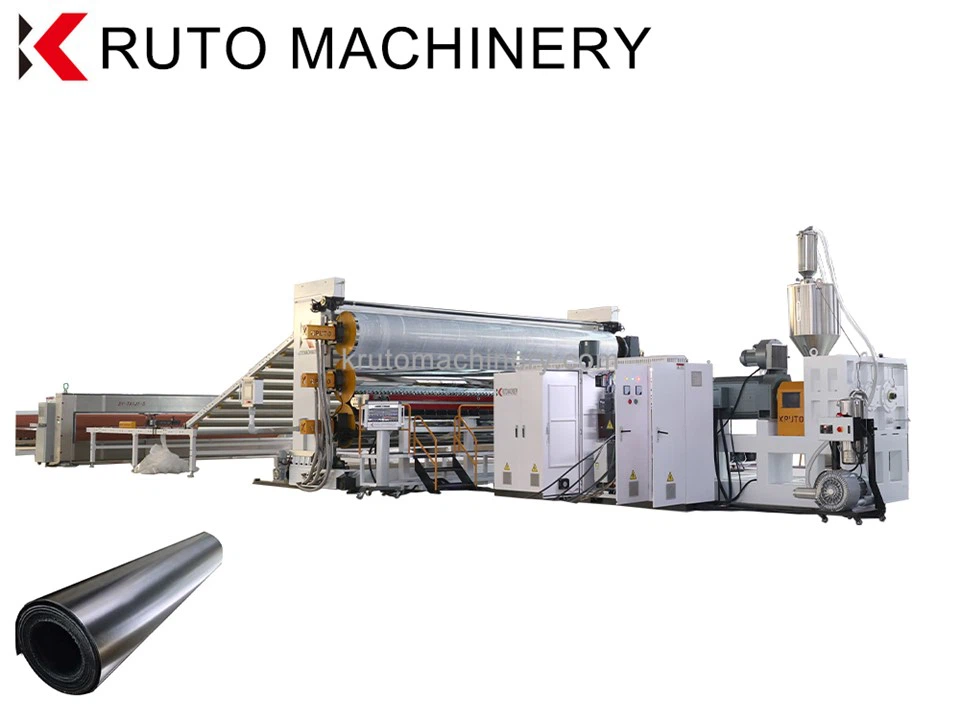
The 5m Width Geomembrane Sheet Machine is another excellent option for customers who require wider geomembrane sheets. It can produce 5 - meter - wide HDPE geomembranes with customizable electrical conductivity. Our engineers can adjust the manufacturing parameters to meet the specific conductivity requirements of different applications.
For customers who need extra - wide geomembranes, our Extra Width 7m PE PP LDPE HDPE Geomembrane Production Line is the ideal choice. This production line can produce 7 - meter - wide geomembranes with high precision and consistent electrical conductivity.
Measuring the Electrical Conductivity of Geomembranes
There are several methods available for measuring the electrical conductivity of geomembranes. One common method is the four - point probe technique. In this method, four electrodes are placed on the surface of the geomembrane, and a current is passed through the outer two electrodes. The voltage is then measured between the inner two electrodes. Using Ohm's law, the electrical conductivity can be calculated from the measured current and voltage values.
Another method is the surface resistance measurement. A pair of electrodes is placed on the surface of the geomembrane, and the resistance between them is measured. The surface resistance is then used to calculate the electrical conductivity.
Importance of Controlling Electrical Conductivity
Controlling the electrical conductivity of geomembranes is essential for ensuring their proper performance in different applications. In environmental applications, a geomembrane with the wrong electrical conductivity can lead to inaccurate geophysical survey results or ineffective containment of contaminants. In electrical applications, improper conductivity can result in electrical failures and safety hazards.
Our Geomembrane Production Lines are designed to produce geomembranes with precisely controlled electrical conductivity. We conduct rigorous quality control tests during the manufacturing process to ensure that each geomembrane sheet meets the specified conductivity requirements.
Conclusion
In conclusion, the electrical conductivity of geomembranes is a complex property that is influenced by material composition, manufacturing process, and thickness. Our Geomembrane Production Lines are capable of producing geomembranes with a wide range of electrical conductivity values to meet the diverse needs of our customers. Whether you need a highly insulating geomembrane for electrical protection or a slightly conductive one for geophysical surveys, we have the technology and expertise to deliver.
If you are interested in our products or have specific requirements regarding the electrical conductivity of geomembranes, we invite you to contact us for a detailed discussion. Our team of experts is ready to assist you in choosing the right Geomembrane Production Line and geomembrane products for your project.
References
- ASTM D4496 - Standard Test Method for DC Electrical Resistance of Carbon - Black - Filled Polyethylene Geomembranes
- Koerner, R. M. (2012). Designing with Geosynthetics. Pearson.
- Rowe, R. K. (2005). Geosynthetics in Waste Containment Landfills. CRC Press.